

Real stories of transformation through dedicated learning
The Learning Journey
Web design is more than just a trendy career path—it’s a creative and technical skill set that opens doors.
Over the past few years, we’ve watched students from various backgrounds transform into skilled professionals through our 1-year web design program.
Their stories offer insights into what’s possible with the right guidance, dedication, and structured learning approach.
The Web Design Learning Process
Learning web design is both art and science—requiring creative vision alongside technical expertise.
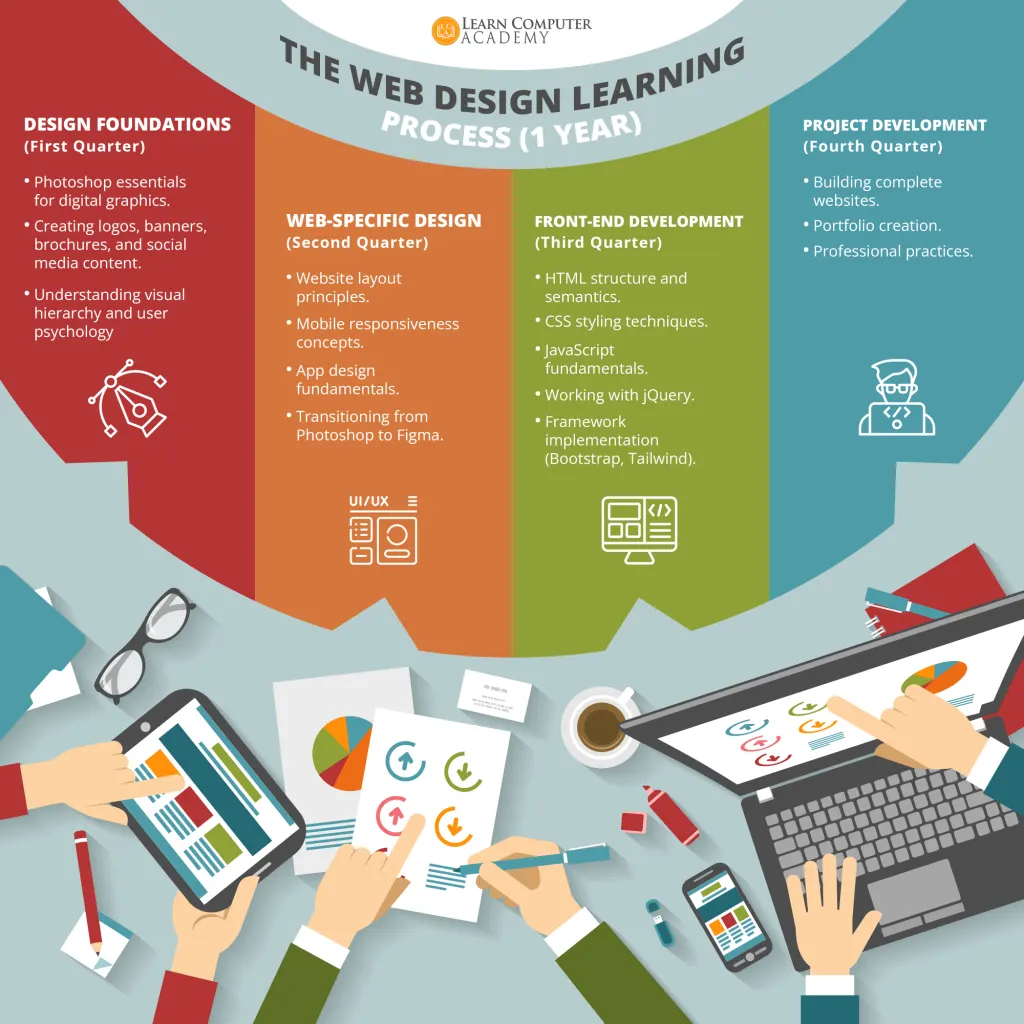
Our students discovered this balance through a carefully structured curriculum that builds skills progressively:
- Design Foundations (First Quarter)
- Photoshop essentials for digital graphics
- Creating logos, banners, brochures, and social media content
- Understanding visual hierarchy and user psychology
- Web-Specific Design (Second Quarter)
- Website layout principles
- Mobile responsiveness concepts
- App design fundamentals
- Transitioning from Photoshop to Figma
- Front-End Development (Third Quarter)
- HTML structure and semantics
- CSS styling techniques
- JavaScript fundamentals
- Working with jQuery
- Framework implementation (Bootstrap, Tailwind)
- Project Development (Fourth Quarter)
- Building complete websites
- Portfolio creation
- Professional practices
Let’s see how this approach worked for five of our recent graduates.
Student Success Stories
Bittu Sarkar: Finding His Technical Groove

Bittu joined us after completing his studies at Gobardanga Hindu College in West Bengal. Living in Gobardanga, his options for specialized tech education were limited.
“I had basic computer knowledge but didn’t know where to focus my energy,” Bittu shares.
The structured curriculum helped Bittu discover his strengths in front-end development. While he enjoyed the design aspects, he truly excelled when learning HTML and CSS.
His portfolio—viewable at bittusarkar2004.github.io/portfolio/—showcases clean code and thoughtful user interfaces.
After completing the program, Bittu relocated to Delhi for a position at MimansaTech, where he now builds websites for businesses across North India.
Arijit Mondal: Analytical Mind Meets Creative Design

Coming from Ashoknagar with a background from Haripur College, Arijit brought analytical thinking to his web design studies.
“The integration of design principles with logical coding structures clicked for me,” Arijit explains. “I could see how both sides worked together.”
His approach to projects was methodical—first understanding the goal, then planning the visual structure, and finally implementing with clean code.
This systematic approach made him an ideal candidate for WeaversWeb, where he now applies both his design eye and technical skills to client projects.
Preety Biswas: Balancing Education and Professional Growth

Preety’s story is particularly inspiring as she balanced her college studies at Gobardanga College with our web design program.
Living in Maslandapur, she initially questioned whether she could manage both commitments.
“The practical nature of the web design curriculum actually complemented my theoretical college courses,” Preety notes.
Her natural talent for visual design flourished through the Photoshop and Figma portions of the program. Her portfolio of social media graphics and branding packages impressed a local agency.
Before even completing her college degree, Preety secured a position as a Graphics Designer, applying her new skills while continuing her education.
Anup Banerjee: From Technical Curiosity to Expertise

After studying at Netaji Satabarshiki Mahavidyalaya in Ashoknagar, Anup had a natural curiosity about how websites functioned behind the scenes.
“I was the person always wondering how elements moved and responded on websites,” he recalls.
While he appreciated design concepts, Anup’s passion emerged during the coding segments of the curriculum. He took to JavaScript, like many of our web design students with particular enthusiasm, spending extra hours experimenting with interactive features.
His dedication paid off with an initial position at Minerva Infotech, followed by career advancement to Liberating Solution, where he now develops web applications.
Sanjana Maity: Transition Through Digital Skills
Originally from Chandpara, Sanjana was looking for skills that could open opportunities beyond her hometown.
“I wanted to work in a creative field in Kolkata, but wasn’t sure which path would get me there,” she shares.
The comprehensive nature of our program helped Sanjana identify her strengths in UI design and prototyping. Her Figma projects consistently demonstrated strong visual communication and user-focused thinking.
Upon completing the program, she successfully secured a position at Klizo Solutions in Kolkata as a Front-End Designer—achieving her goal of building a creative career in the city.
What Our Graduates Learned

Beyond specific technologies, our students developed:
- Technical Foundations
- HTML5 structure and semantics
- CSS3 styling and animations
- JavaScript functionality
- Design tool proficiency
- Project Experience
- Responsive website creation
- Interactive interface elements
- Visual asset development
- Collaboration workflows
- Professional Skills
- Problem-solving approaches
- User experience thinking
- Project management basics
- Portfolio development
The Real-World Application
The progression from learning to employment wasn’t automatic—it required applying classroom knowledge to practical situations.
“The transition from exercises to client-ready work was challenging,” remembers Ujjal Mondal, who also completed our program and now works at MimansaTech alongside Bittu.
“But having created multiple complete projects during the course gave me the confidence to handle real client requirements.”
This practical experience proved valuable for all our graduates as they entered the job market.
Where They Are Now
Our former students now contribute their skills across various companies:
- Bittu Sarkar and Ujjal Mondal: MimansaTech
- Arijit Mondal: WeaversWeb
- Anup Banerjee: Initially at Minerva Infotech, now at Liberating Solution
- Krishanu Debnath: Skyram Technologies
- Apu Das: MSR Limited
- Suman Das: ExnoWeb
- Sanjana Maity: Klizo Solutions
- Tushar Majumdar: DreamzTech
Many started in local positions before advancing to bigger opportunities or remote roles.
Learning Environment Factors
What elements of the learning environment contributed to these outcomes?
Three key factors stand out in our web design students feedback:
- Structured skill progression that built competence step-by-step
- Regular practice with feedback from experienced instructors
- Peer collaboration that mimicked professional team environments
“Having classmates to troubleshoot with and instructors to guide us made all the difference,” says Krishanu Debnath. “We learned not just from the curriculum but from each other.”
Web Design as a Career Path in India
For students considering web design as a career, the timing is favorable in India.
The digital transformation across industries has created steady demand for professionals who understand both design principles and technical implementation.
“Companies are looking for people who can bridge the gap between visual appeal and functionality,” notes Suman Das, now working at ExnoWeb.
This demand extends beyond major tech hubs to smaller cities as businesses everywhere seek to establish or improve their digital presence.
Continuing Growth After Graduation
The learning journey doesn’t end with program completion.
Many graduates have continued expanding their skills:
- Some specialize further in UI/UX design
- Others deepen their development expertise
- Several have explored frameworks like React JS
- A few have added WordPress customization to their services
“The foundation gives you confidence to learn whatever new technologies emerge,” explains Shekhar Biswas, who has since added several JavaScript frameworks to his skill set.
Key Takeaways for Aspiring Web Designers
What can others learn from these success stories?
- Start with fundamentals before specializing
- Build real projects as you learn
- Develop both design and technical skills for versatility
- Create a compelling portfolio that demonstrates capabilities
- Connect with others in the field for support and opportunities
Web Design Student FAQs
Q: Is prior experience necessary? A: No—most of our successful students started with basic computer literacy but no specific design or coding knowledge.
Q: How much practice is needed outside of class? A: Regular practice is essential. Students typically spent 10-15 hours weekly on projects beyond class time.
Q: Can I specialize in either design or development? A: While our program covers both, many students naturally gravitate toward one area. Understanding both sides makes you more versatile.
Q: How important is having a portfolio? A: Critical—every student mentioned that their portfolio projects were key discussion points in job interviews.
The Continuous Learning Mindset
Perhaps the most important lesson from our graduates is the value of continuous learning.
“Web technologies change constantly,” shares Apu Das, now at MSR Limited. “The most valuable skill I gained wasn’t any specific language or tool, but knowing how to adapt and learn new ones as needed.”
This mindset has served our graduates well as they navigate their evolving careers.
Learning Web Design in West Bengal
For students in West Bengal considering web design education, these success stories demonstrate what’s possible through dedicated learning and practice.
With the right guidance and commitment, the skills gap can be bridged, opening doors to opportunities both locally and beyond.
The journey from beginner to professional isn’t always straightforward, but as these stories show, it’s certainly achievable within a focused learning timeframe.
Learn Computer Academy in Habra, West Bengal, offers comprehensive web design training. See more student work and success stories on our website.


