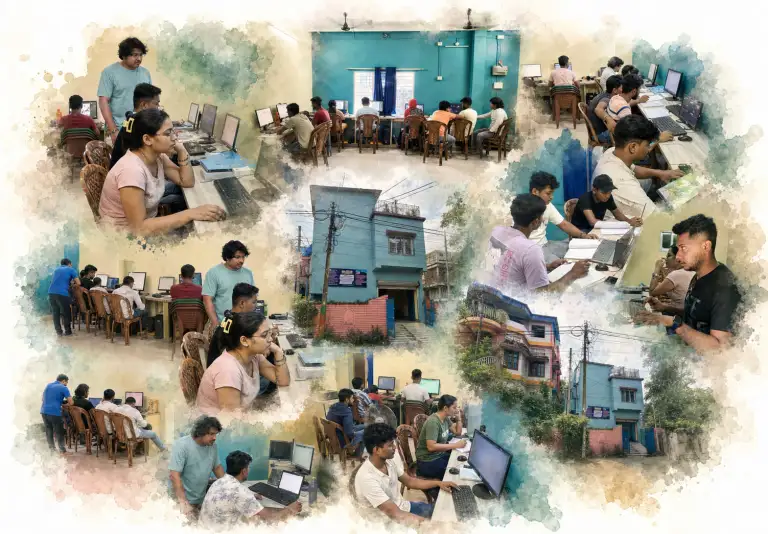
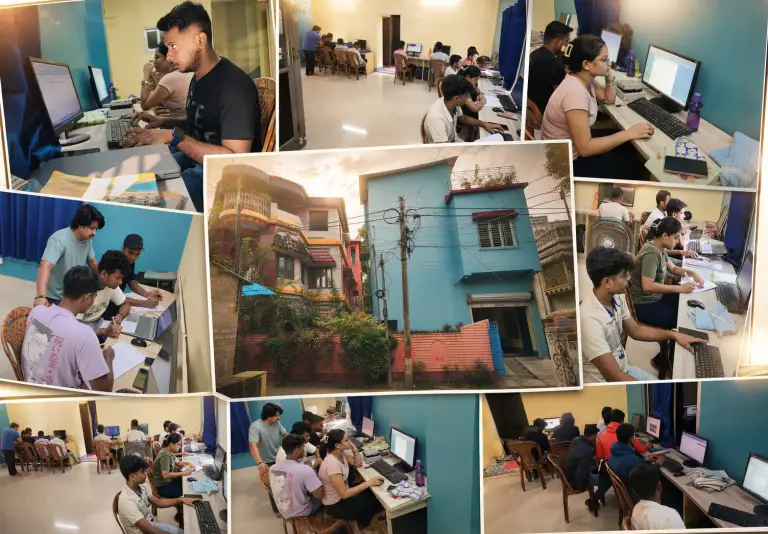
A third-year CSE student came to our Habra centre one evening. His CGPA was good. He had cleared every semester. But when I asked him to write a small Python program that prints numbers from 1 to 10, he sat quietly for two minutes. Then he smiled and said, “Sir, ami toh sob bhule gechi” (Sir, I have forgotten everything).
He is not a weak student. He is a very normal one. Every year we meet ten or twelve students exactly like him, from CSE, BCA and BSc IT, in colleges around Habra, Barasat and Kolkata. So this guide is written for him. Python for CSE students who still cannot write code is not about starting life again from zero. It is about closing the gap in six months, without missing a single college class.
Why Third Year Arrives and the Coding Still Does Not
Nobody plans for this. It happens slowly.
College exams reward theory. So you can write C code on answer paper, score well, and never run it on a computer. The lab period is short. Computers are shared. And the lab file often gets copied from a senior’s notebook the night before submission.
But here is the real problem. Nobody fails you for not coding. So the gap stays hidden through first year, then second year. Then placement season arrives in the seventh semester, and suddenly it is visible to everyone, including you.
There is another reason, and it is quieter. Many students have already “learnt” Python from a long video. They watched twelve hours. They understood everything while watching. However, they never typed a single line themselves. Watching is not learning. Your hands have to make the mistakes.
What a Placement Test Actually Checks
Before making any plan, understand the target. Most large IT companies follow the same three steps: an online test, then one or two technical interviews, then an HR round. The online test removes the largest number of students.
| Round | What it contains | Where Python helps |
|---|---|---|
| Online test | Quantitative aptitude, logical reasoning, verbal ability, and one or two coding problems | Only in the coding part — and you usually pick your own language |
| Technical interview | Your project, basic data structures, OOP, DBMS, operating systems | Yes, if the project is yours and you can explain the code |
| HR round | Communication, relocation, salary discussion | Not at all |
Now read that table again and notice something. Coding is only one part of the test. Aptitude and reasoning are there too, and many good coders lose exactly there. So treat Python for CSE students as one half of your preparation. Keep an aptitude book open alongside it.
Two more honest points. First, coding rounds at companies like Accenture accept C, C++, Java and Python, so nobody is forcing one language on you. Second, the money. Most freshers hired through mass drives start at roughly ₹3.3 to ₹4.5 lakh a year, which is about ₹22,000 to ₹30,000 in hand per month. Higher tracks such as TCS Digital or Infosys Digital Specialist pay around ₹6 to ₹9.5 lakh, and a small number of specialist offers go much higher. Please confirm current figures before you believe any number, including mine, because these change with every hiring cycle.
Python for CSE Students: A 6-Month Plan That Fits Around College
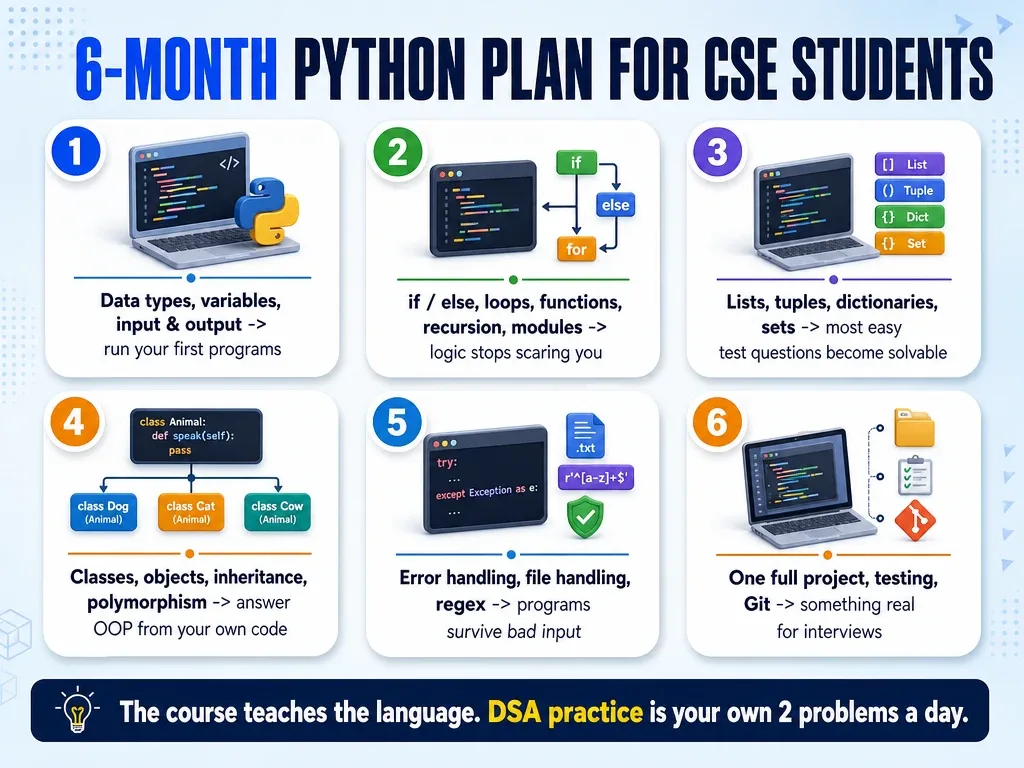
This is the actual month-by-month structure we follow in our Python batches. I am putting it here openly, so you can copy it even if you never join us.
| Month | What you learn | What it unlocks |
|---|---|---|
| 1 | Data types, variables, operators, input and output | You write and run your own first programs |
| 2 | if / else, loops, functions, recursion, modules | Simple logic questions stop scaring you |
| 3 | Lists, tuples, dictionaries, sets | Most easy coding-test questions become solvable |
| 4 | Classes, objects, inheritance, polymorphism | You answer OOP interview questions from your own code, not from notes |
| 5 | Error handling, file handling, regular expressions | Your programs stop breaking on the first wrong input |
| 6 | One complete project, testing, Git | You finally have something real to talk about in an interview |
Now the honest part, and please do not skip it. This plan teaches you the language. But it does not replace data structures and algorithms practice for placements. DSA is your own daily work: two problems a day, every day, in the language you have just learnt.
In other words, Python for CSE students builds the foundation. Your daily problem solving builds the score. A course gives you the tool and shows you how to hold it. However, the practice hours are still yours.
Month six matters more than students expect. A project you built yourself, and can explain line by line, is worth more in an interview than four certificates. Interviewers ask “why did you do it this way”, and only your own project survives that question.
How Many Hours a Week Does It Really Need?
Less than students fear. Python for CSE students works on rhythm, not on marathon sessions. Here is a week that has worked for many of our college students.
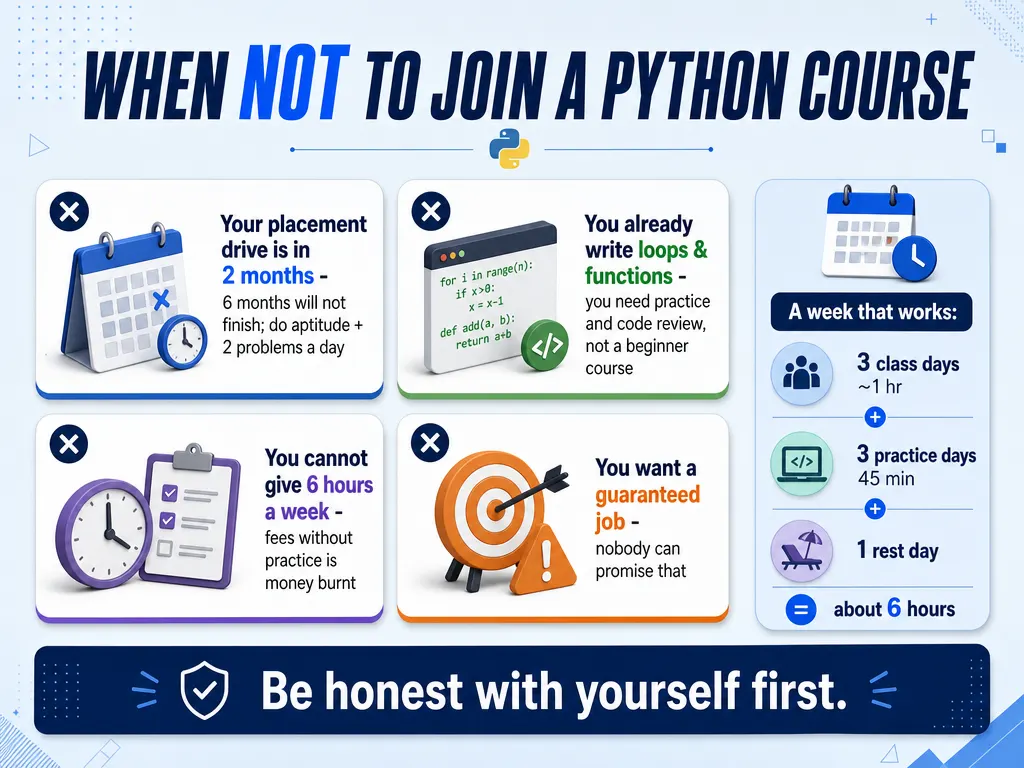
- Three class days — about one hour each, after your college hours.
- Three practice days — 45 minutes at home, typing what you learnt, not reading it.
- One rest day — really rest. Sunday off is fine.
That is roughly six hours a week. It is less time than most students spend on Instagram in two days. Therefore the difficulty is never the number of hours. It is doing it in the weeks when college has internals, or a fest, or a festival at home. Those weeks will come. So do thirty minutes instead of zero, and the habit survives.
One warning. Do not study at 1 am after a full college day. Tired practice builds a false feeling of effort and teaches you almost nothing.
When You Should Not Join a Python Course
Python for CSE students helps many people, but it is not right for everyone. I would rather tell you this now than take your money and disappoint you later.
- Your placement drive is in two months. Six months will not finish in time. So drop the course. Instead, do daily aptitude practice and two coding problems a day in whatever language you already half-know. That is the better use of eight weeks.
- You can already write loops and functions comfortably. Then you do not need a beginner course. You need practice and someone to review your code. Start with the free official Python beginner guide on python.org and go straight to problem solving.
- You cannot give six hours a week. Be honest with yourself. Because fees paid without practice hours is money burnt, and we have watched it happen.
- You want a guaranteed job. Nobody in this town, or any town, can promise that. Any centre that promises it is lying to you. We give training, projects and job assistance. But the interview is still yours to clear.

Python, C or Java — Which One for Placements?
Students ask this in every counselling session, so here is a short answer.
Your college syllabus will keep C, and probably Java. Do not fight your syllabus, because you still have to pass those papers. But for the coding round, you usually choose the language yourself. And Python takes the fewest lines, so in a timed test you finish faster and make fewer typing mistakes.
If your target is a core product company, then C++ or Java with very strong DSA is the more common road. For most service companies, however, and for a first job from a college in our area, Python for CSE students is a safe and fast choice. If you are still deciding between courses, our comparison of courses that actually lead to jobs goes into the trade-offs in more detail.
Pick one language. Stay with it for six months. Changing language every month is the commonest way students waste a year.
Five Mistakes We See Every Single Year
We have watched Python for CSE students go wrong in the same five ways, year after year. None of them is about talent.
- Watching, not typing. A twelve-hour video finished in three days teaches almost nothing if your keyboard stayed cold.
- Changing the language every month. Python in July, Java in August, C++ in September, nothing by December.
- Copying the lab file. It saves one night and costs you two years.
- Waiting for final year. Second year is the comfortable time to start. Third year is still fine. Final year is a rush.
- Learning completely alone. Your code runs, but nobody tells you it is written badly. So a teacher or a senior who reviews your code is worth a lot.
Questions College Students Ask Us
I am in BCA, not CSE. Is this plan different?
No. BCA, BSc IT and CSE students sit in the same batch here and follow the same six months. Python for CSE students and for BCA students is identical. Only your college syllabus differs, not the language.
Will a certificate help me in placement?
Honestly, only a little. A certificate gets a line on your CV. But the project, and your ability to solve a problem in front of an interviewer, get the offer. We do provide certification after an exam for an extra fee of ₹500. Still, please join for the skill and not for the paper.
Can I finish it in the college holidays only?
Not really, and I would not recommend trying. Coding needs repetition spread over weeks. A one-month crash batch feels productive, and then it fades by the next semester.
What does it cost?
Our Python training runs six months at ₹2,000 per month, taken at the start of each month. There is no separate admission fee — the first month’s fee is simply paid on the day you join. Certification after the exam costs ₹500 extra. You can see the full module list on the Python training course page.
I stay in Bangaon, Gobardanga or Ashoknagar. Is it practical?
Many of our students travel in on the Bongaon line. Three evenings a week is manageable if you fix the batch timing around your train. So talk to us before joining, and we will try to place you in a batch that matches your journey.
Where to Start This Week
Python for CSE students starts with one program, not with one payment. You do not need to decide about any course today. But you do need to write something this week. Open a computer, install Python, and print your own name on the screen. That single step separates the students who fix this problem from the students who only talk about fixing it.
After that, if you want a teacher, a batch of six and a fixed weekly rhythm, come and sit in a free demo class at our Habra centre and see whether it suits you. No fees, no forms, no pressure. And if you are comparing a few centres first, that is sensible. Our guide on what to check before paying any coaching centre will help you ask better questions, at our place or anywhere else.
Six months from now, you can be the CSE student who writes code, or the one still saying sob bhule gechi. That third-year student from the beginning of this post? He chose the first one. He is in month four now, and last week he explained his own class-and-object code to me without opening his notes.
Learn Computer Academy — Khudiram Basu Road, Saptapalli More, Habra. Call +91 8918 560 266 to book a free demo class, or drop in any evening and ask for a five-minute look at the Python batch.