Your child’s school offers an AI subject class 10 option — and suddenly the dinner table has questions. What is this subject? Is it tough? Will it help later? In this post I will explain the CBSE and ICSE AI subject in the simplest possible language, for parents AND students.
A mother called us some months ago, worried.
Her son’s school had offered “Artificial Intelligence” as a subject choice. The syllabus paper had words like “Computer Vision” and “Advanced Concepts of Modelling”.
“Eto kothin jinis, class 10-er chhele parbe?” (Such hard things — can a class 10 boy manage?)
I explained the syllabus to her in ten minutes, in plain words. By the end she laughed and said, “Oh, this much? The names are scarier than the subject!”
Exactly. So let me give you the same ten minutes.
What Is the AI Subject in School?
CBSE introduced Artificial Intelligence as an optional skill subject starting from class 9, back in the 2019–20 session. Today it runs through class 10 (subject code 417) and continues in classes 11–12 (code 843). Many ICSE/ISC schools have also added Robotics and AI subjects.
Important word: optional. It sits alongside the main subjects as a skill subject — the same family as IT. Schools choose to offer it; students choose to take it.
The goal is not to make 15-year-olds into engineers. The goal is to make them comfortable with how AI thinks and works — the way earlier generations learned “computer basics” in school.

AI Subject Class 10 (CBSE Code 417): The Full Picture
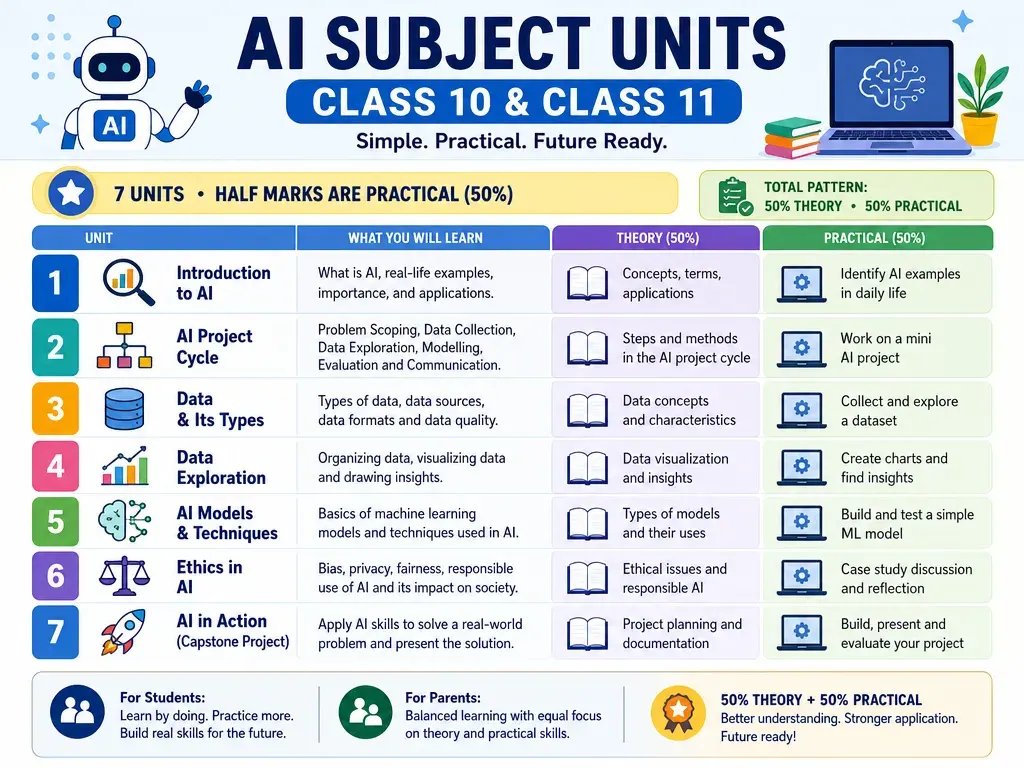
The paper is 100 marks — 50 theory + 50 practical. That 50-mark practical is the first good news: half the marks come from doing activities and projects, not from memorising.
The syllabus has two parts:
Part A: Employability Skills (10 marks). Communication, self-management, basic ICT, entrepreneurial thinking, and green skills. Simple, life-useful chapters — nothing technical.
Part B: The AI units. These are the ones with the scary names. Let me translate each into normal language:
- AI Project Cycle & Ethical Frameworks — the step-by-step method of any AI project (find problem → collect data → build → check), plus right-and-wrong questions about AI. Think of it as “how to plan a science project” with an AI flavour.
- Advanced Concepts of Modelling in AI — the scariest name, the friendliest chapter. It simply explains the two ways machines become smart: following written rules, or learning from examples. That is genuinely the core idea.
- Evaluating Models — checking the AI’s homework. Did the AI guess right or wrong, and how do we count its score? Involves a little easy calculation (this unit carries good marks, so practise it).
- Statistical Data — making sense of numbers with charts and simple maths. Class-10-level, not college statistics.
- Computer Vision — how machines “see” images. Why your phone recognises your face. Mostly concepts and fun examples.
- Natural Language Processing (NLP) — how machines understand human language. Why ChatGPT understands your Bengali-mixed English.
- Advanced Python — small, gentle programming exercises. “Advanced” here means advanced for class 10 — which means quite basic in the real world. No fear needed.
You can download the official unit-wise syllabus from the CBSE Academic website (Code 417 PDF) — it is public and free.
And in Class 11 & 12?
In classes 11–12, AI continues as an elective (CBSE code 843). The same ideas go one level deeper — more Python, more data handling, more real machine learning concepts. A student who did AI in class 9–10 walks into it comfortably.
For ICSE/ISC families: CISCE schools increasingly offer Robotics and AI subjects, but exact offerings differ school to school. One phone call to your school office gives you the exact answer — ask which code and which classes.
Should Your Child Take This Subject? (Honest Answer)
Take it if: your child is curious about phones, apps, and how things work; the school teaches it properly (ask seniors!); and you want a scoring, future-facing subject. The 50-mark practical makes it one of the friendlier scoring subjects for a regular student.
Think twice if: the school offers it only on paper with no proper teacher or computer lab — a badly-taught skill subject is worse than a well-taught traditional one. The subject is only as good as its teaching.
And one myth to break: NOT taking AI in school does not close any doors. Plenty of students start AI after 12th and do wonderfully — I mapped all those routes in AI Courses After 12th. School AI is a head start, not a gate.
How Parents Can Help (Without Knowing Any AI)
You do not need to understand Computer Vision to support your child. Three things help enormously:
- Give computer time without guilt. For this subject, practice on a computer IS the homework. A basic home computer or even regular access helps; the practical marks depend on it.
- Ask them to teach YOU. “Explain what you learned today, simply” — teaching parents is the best revision a child can do. And you will enjoy it more than you expect.
- Let them use real AI tools for study. ChatGPT explaining a hard chapter is not cheating — it is a free tutor. I listed the best ones in AI Tools for Students.
Where Extra Coaching Fits (And Where It Does Not)
Honest section, as always.
For the theory units, the school book plus free online notes are usually enough — do not rush to buy tuition for a skill subject.
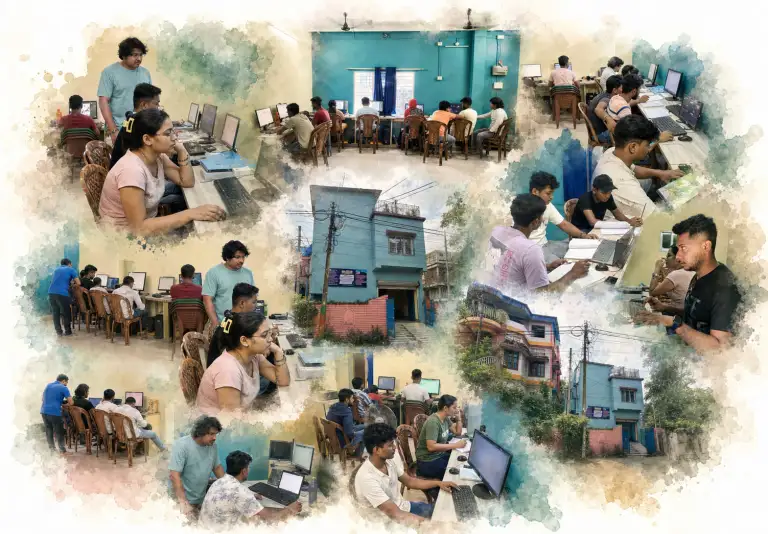
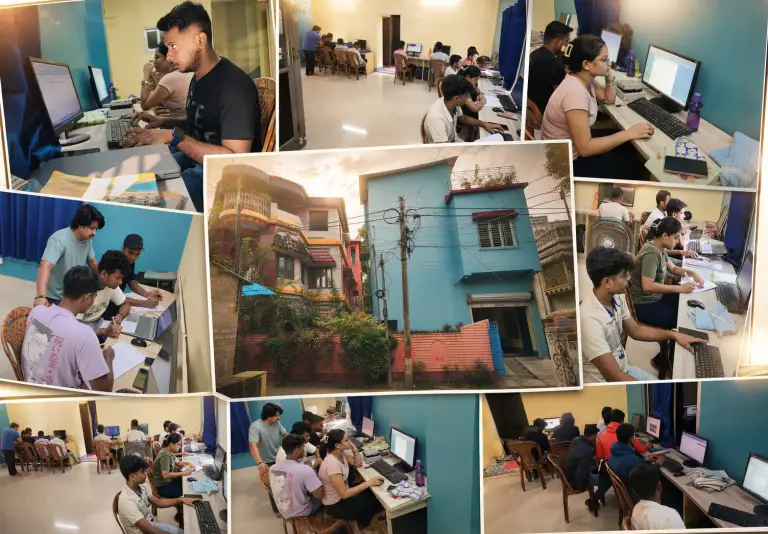
Where outside help genuinely adds value is the hands-on side — getting comfortable with real AI tools, small Python practice, and building the confidence that the school lab (often crowded, often rushed) cannot give. At our Habra centre, we see school students in our AI Course for Beginners whose school AI marks jump simply because the subject stopped feeling foreign.
FAQ: School AI Subject
Is the AI subject tough for an average student?
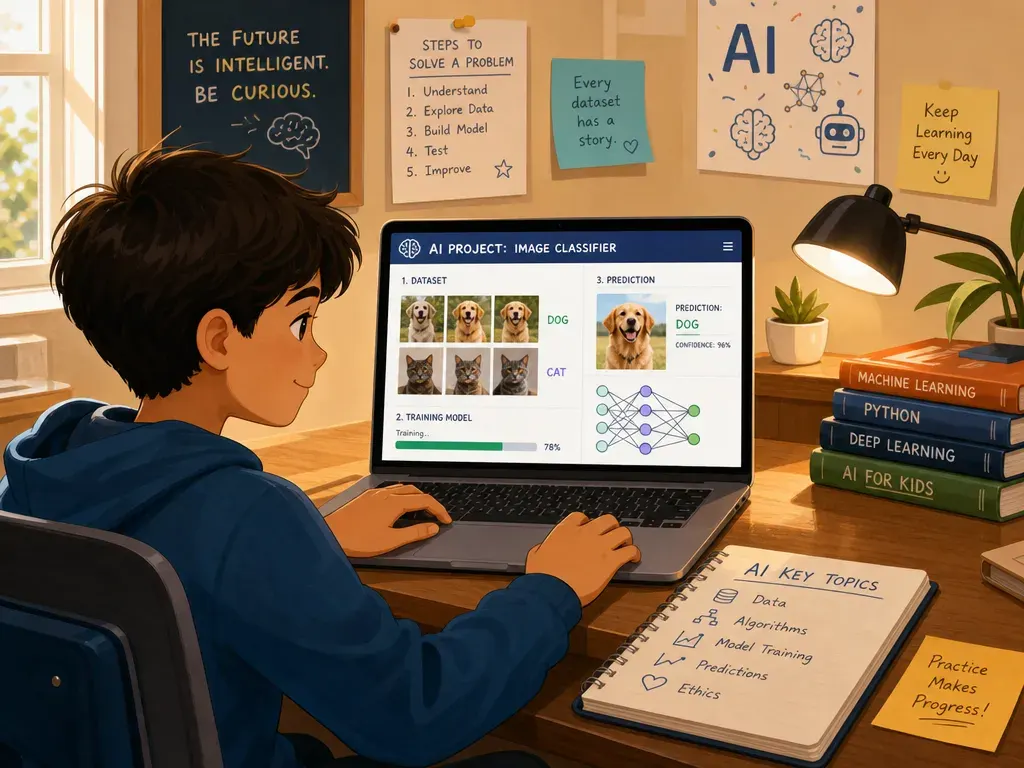
No. The names are tough; the content is friendly. Half the marks are practical, the maths is light, and most units are concept-and-example based. Average students regularly score very well in it.
Does the child need a computer at home?
It helps a lot but is not compulsory — school labs cover the official practicals. A basic or second-hand computer at home turns “manageable” into “comfortable”, especially before practical exams.
Will school AI help in future careers?
Yes, as a foundation. The child meets ideas at 15 that others meet at 20. But remember the flip side too — students who never took school AI can still catch up fully with a few months of learning later. Head start, not life sentence, either way.
AI subject or IT subject — which one to pick?
Both are good skill subjects. IT is the safer classic (office software, general computing); AI is the newer, more future-facing one with slightly more concepts. If the school teaches both well, AI has the longer runway. If the AI teaching is weak, well-taught IT wins.
Final Words
Back to that worried mother.
Her fear was never really about the syllabus. It was about the unknown — big English words standing between a parent and her child’s education.
Now you have the translation. Project cycle = planning method. Modelling = how machines learn. Evaluation = checking the machine’s score. Computer Vision = machines seeing. NLP = machines reading.
Nothing in that list is beyond a class 10 student. And nothing in it is beyond a parent’s understanding either — you just proved that by finishing this post.
Want your school-going child to get comfortable with AI hands-on? Bring them to our Habra centre for a free demo class, or see the AI Course for Beginners page. School students are some of our happiest learners.