AI vs machine learning vs generative AI — three words that confuse almost every beginner. Today I will explain all three with examples from your daily life. UPI, Swiggy, Google Maps. Things you already use.
In our classes at Habra, one question comes again and again.
“Sir, AI and machine learning — same thing or different?”
And now a third word has joined the party: generative AI.
News channels use these words. YouTube uses these words. Job advertisements use these words. But nobody explains them in simple language.
So let us fix that today. Give me 10 minutes. You will never be confused again.
AI vs Machine Learning: The One-Line Difference
Here is the simplest way to remember it:
- AI (Artificial Intelligence) = the big dream. Making machines think and act smart, like humans.
- Machine Learning (ML) = one method to reach that dream. Machines learn from data, without step-by-step instructions.
- Generative AI = the newest child of the family. AI that can CREATE new things — text, images, videos, music.
Still confusing? Then think of it like education.
AI is like “education” — the full big idea. Machine learning is like “learning from practice” — one way of getting educated. And generative AI is like a student who studied so much that now he can write his own poems and draw his own pictures.
One sits inside the other. All machine learning is AI. But not all AI is machine learning. And generative AI is a special type of machine learning.

What Is AI? (Artificial Intelligence)
AI means making a computer do work that normally needs human intelligence.
Understanding language. Recognising faces. Making decisions. Solving problems.
Everyday examples of AI you already use:
- Google Maps traffic — it looks at thousands of phones on the road and tells you, “Jessore Road has heavy traffic, take another route.” That decision-making is AI.
- Phone face unlock — your phone recognises YOUR face out of 800 crore faces in the world. That is AI.
- Voice typing in Bengali — you speak, the phone writes. Understanding speech is AI.
- Spam filter in Gmail — fake lottery emails go straight to spam. You never even see them. AI did that quietly.
See? You have been using AI for years. You just never called it AI.
What Is Machine Learning? (ML)
Now go one step deeper. HOW does a machine become smart?
Old way: a programmer writes every rule by hand. “If email contains the word LOTTERY, mark it spam.” But cheaters change words. Rules fail.
New way: show the machine 10 lakh spam emails and 10 lakh good emails. The machine studies them and finds the patterns BY ITSELF. This is machine learning. Learning from examples, not from rules.
Just like a child learns to recognise a cow. You never give the child a rule book about cows. You just show the cow a few times. The child learns from examples.
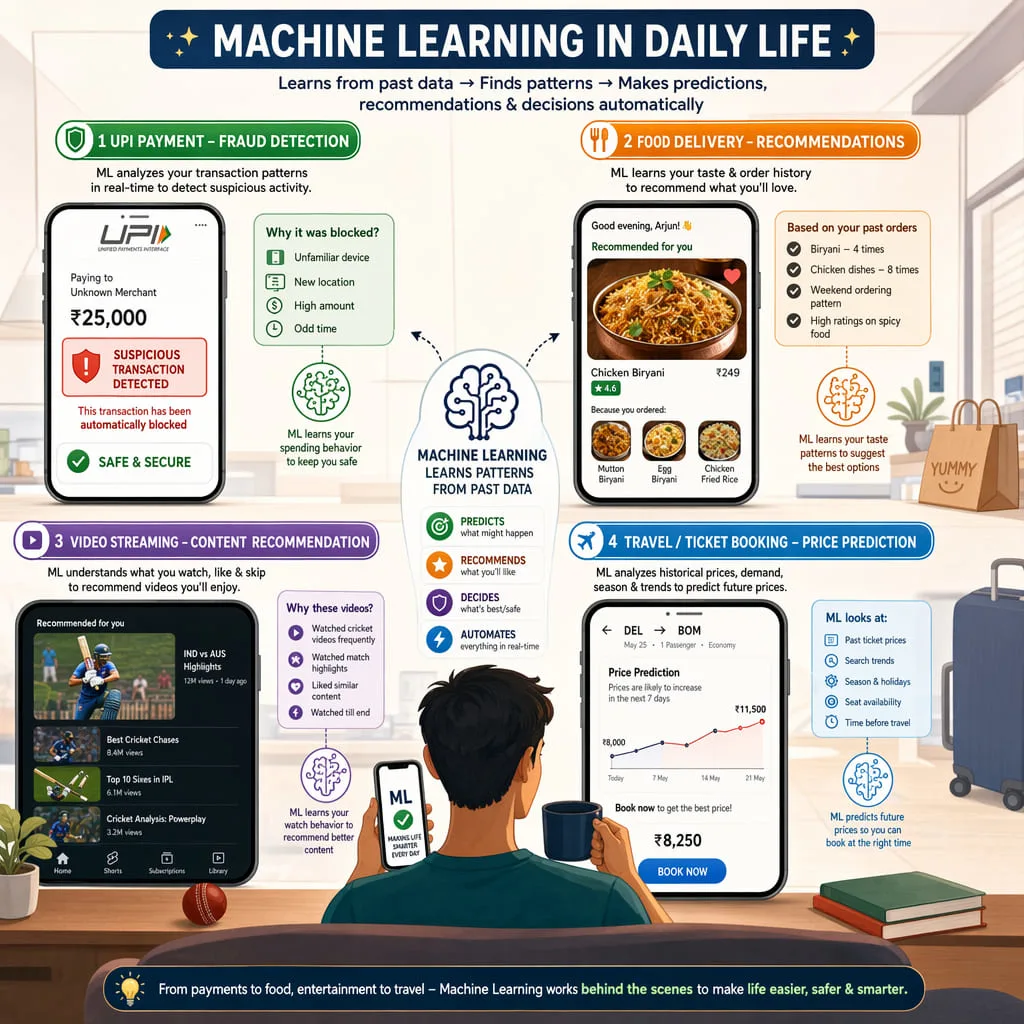
Everyday examples of machine learning:
- UPI fraud detection — you pay ₹50 for tea in Habra every morning. Suddenly one night, ₹40,000 goes to an unknown account from another state. The bank’s ML system knows your pattern and blocks it instantly. It learned YOUR normal behaviour from your past transactions.
- Swiggy and Zomato suggestions — order biryani three Fridays in a row. Next Friday evening, biryani photos appear on top. The app learned your taste from your history.
- YouTube recommendations — watch two videos about cricket, and your whole feed becomes cricket. ML studied your watching pattern.
- Train ticket price prediction apps — they learned from years of old data when prices go up and down.
Notice one thing. In all these examples, ML makes a decision or prediction. Block or allow. Show or hide. Recommend or skip. It does not create anything new.
That “creating” part is the next word.
What Is Generative AI?
“Generate” means to create. So generative AI = AI that creates new things.
Old AI could only judge things. Is this spam or not? Is this a cow or a dog?
Generative AI can MAKE things. Write a full essay. Draw a picture that never existed. Compose a song. Create a video.
Everyday examples of generative AI:
- ChatGPT — ask it to write a leave application in English, and it writes a fresh one in 5 seconds.
- Gemini — Google’s tool that answers questions and creates content, even in Bengali.
- Image tools — type “a Durga Puja pandal on the moon” and the AI draws it. That picture never existed before.
- WhatsApp Meta AI — the blue-purple circle in your WhatsApp. That is generative AI sitting inside your chat app.
This is why the world went crazy after 2022. For the first time, normal people — not engineers — could use powerful AI just by typing simple sentences.
And this is the exact type of AI we teach first, because you can learn it without any coding.
AI vs Machine Learning vs Generative AI: Quick Comparison
| Point | AI | Machine Learning | Generative AI |
|---|---|---|---|
| Meaning | Machines doing smart work | Machines learning from data | Machines creating new content |
| Main job | Think and act smart | Predict and decide | Create text, images, video |
| Example | Google Maps route | UPI fraud alert | ChatGPT writing an essay |
| Age | Old idea (1950s) | Grew big after 2000 | Famous after 2022 |
| For beginners? | Concept to understand | Needs coding to build | Easiest to start using today |
Save this table. Next time someone mixes up these words in front of you, you can smile quietly.
Which One Should a Beginner Learn First?
Simple answer: start with generative AI tools.
Why? Three reasons.
- No coding needed. You type in normal language. That is all.
- Results from day one. Write a resume today. Design a poster today. Motivation stays high.
- Jobs want it NOW. Offices need people who can use ChatGPT, Canva, and AI tools for daily work. This demand is in Kolkata, in Barasat, everywhere.
Machine learning (with Python) can come later, only if you want the engineer path. Most people never need it. I explained this full journey in my post How to Start Learning AI from Zero in 2026.
And if you want to learn generative AI tools properly, step by step, with a teacher in front of you — see our AI Course for Beginners in Habra. Three months. No coding. Real projects.

FAQ: Common Doubts
Is ChatGPT an AI or machine learning?
Both, actually. ChatGPT is generative AI. Generative AI is built using machine learning. And machine learning is a part of AI. Like saying — a mango is a fruit, and a fruit is food. All three names are correct at the same time.
Is deep learning another different thing?
Deep learning is an advanced type of machine learning that uses “neural networks” — a design inspired by the human brain. ChatGPT and image tools are built with deep learning. As a beginner, just remember: deep learning sits inside machine learning. You can read a detailed explanation on Google Cloud’s AI vs ML guide when you are ready for more.
Do I need to know these differences for a job?
For AI tool jobs — you need basic understanding, like what you learned today. It helps in interviews. For engineer jobs — yes, deep technical knowledge is needed.
Will machine learning replace generative AI or opposite?
No. They are not competitors. They are family members doing different jobs. Banks will keep using ML for fraud detection. Offices will keep using generative AI for content. Both will grow together.
Final Words
Let us do a 10-second revision.
AI = the big idea of smart machines. You see it in Google Maps.
Machine learning = machines learning from data to predict and decide. You see it when UPI blocks a fraud payment.
Generative AI = machines creating new things. You see it every time ChatGPT writes for you.
That is it. You now understand something that confuses even many college students.
Next time you order food on Swiggy, pay by UPI, or check Google Maps — pause for one second. Smile. You know what is working behind the screen.
Want to move from “understanding AI” to “working with AI”? Visit our AI Course for Beginners page or drop by our Habra centre. We will guide you honestly.