Prompt engineering for beginners — sounds like a heavy technical subject, right? It is not. It simply means learning to give better instructions to AI. And it is the single most valuable AI skill you can learn in 2026. Today I will teach you the full method in 7 easy steps, with real examples.
Here is something I show in the first class of every AI batch.
I ask two students to get a job application letter from ChatGPT. Same AI, same task, same minute.
Student one types: “write a job application”.
Student two types a proper, detailed instruction (you will learn it below).
Another Student gets a robotic, general letter that could belong to anyone. Student two gets a letter so good it looks professionally written — for HIS exact situation.
Same AI. Different instructions. Completely different results. That gap is what prompt engineering fills.
What Is Prompt Engineering? (Simple Meaning)
A prompt is the instruction you type to an AI like ChatGPT or Gemini.
Prompt engineering is the skill of writing that instruction well, so the AI gives you exactly what you want — in one or two tries, not twenty.
Do not let the word “engineering” scare you. There is no coding, no maths, no degree involved. It is closer to learning how to give good directions to a new employee. The employee (AI) is very capable but knows nothing about your situation — until you tell it.
This is why I call prompting a language skill, not a technical skill. And as I wrote in my post on learning AI without coding, language skills are open to everyone.
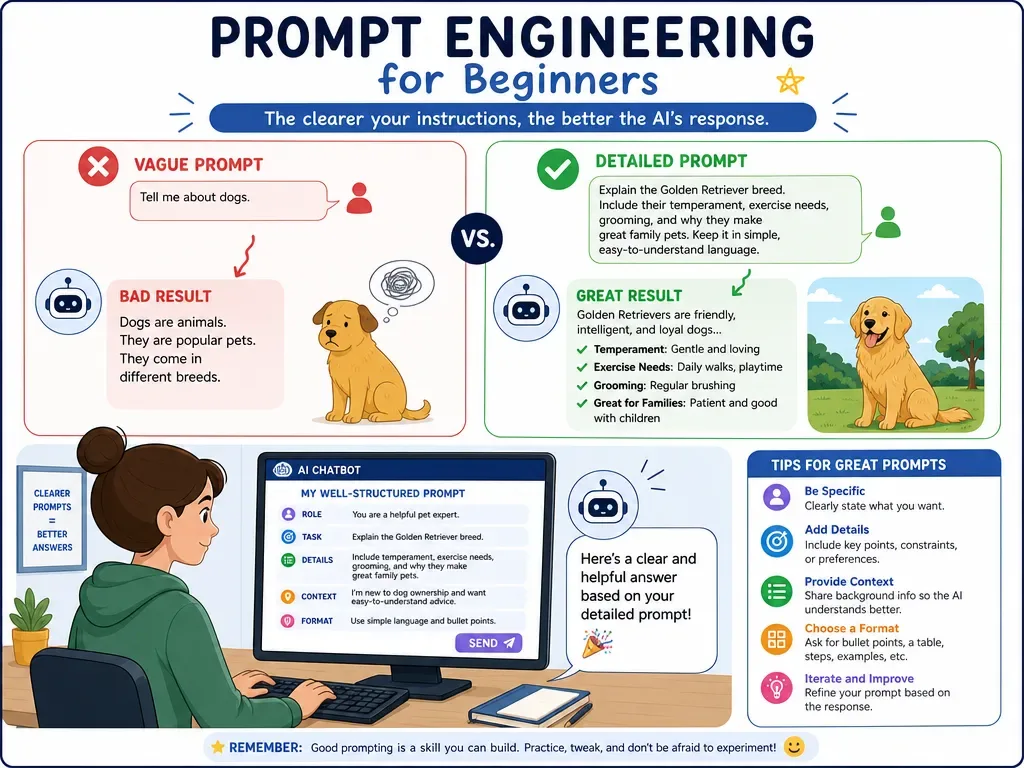
Prompt Engineering for Beginners: The 7 Steps
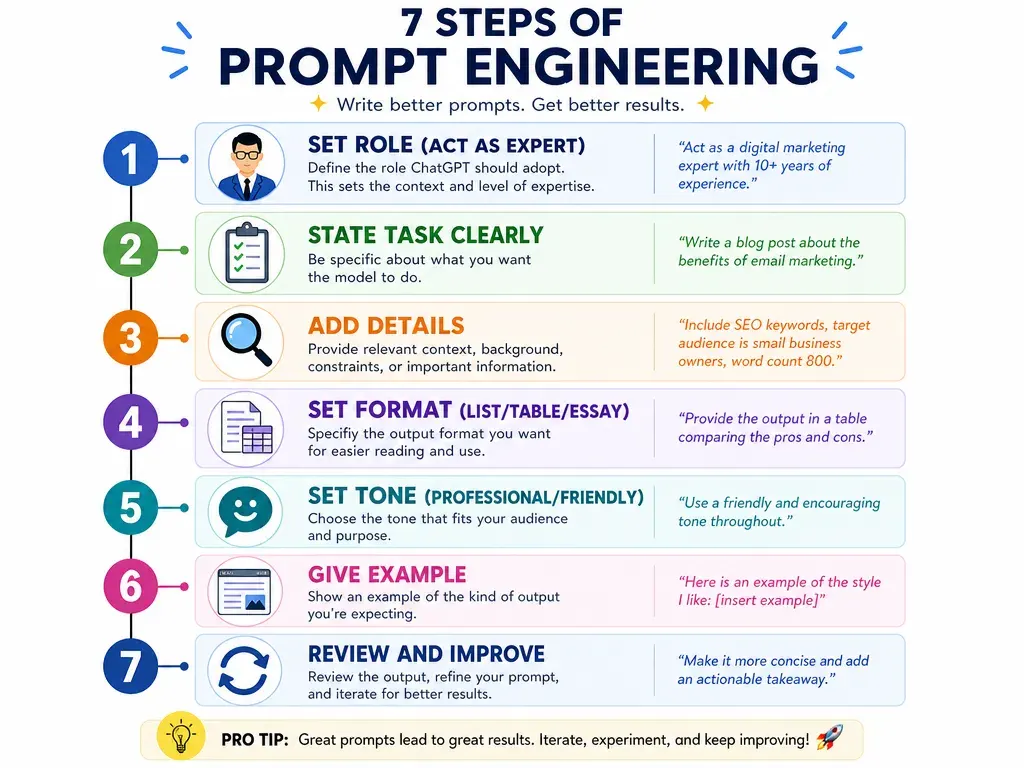
Here is the full method. Each step adds one ingredient to your prompt. Use all seven and watch the magic.
Step 1: Give AI a Role
Start by telling AI WHO it should be. This one line changes the whole quality of the answer.
“You are an experienced HR manager who has read thousands of job applications.”
Now the AI answers like an expert, not like a general machine.
Step 2: State the Task Clearly
One clear sentence about what you want. Not “help me with a letter” — instead: “Write a job application letter for the post of computer operator.”
Step 3: Add Your Details (Context)
This is the step beginners skip — and the step that matters most. AI does not know you. Tell it:
“I am a B.A. graduate from Habra, West Bengal. I completed a 3-month AI tools course. I know MS Office, Canva, and ChatGPT. This is my first job application. The company is a local coaching centre.”
More true details = more personal, believable result.
Step 4: Set the Format
Tell AI what shape you want the answer in. “Give it as a formal letter, under 200 words.” Or “Give me a table.” Or “Give me 5 bullet points.” Without this, AI decides the shape — and often decides wrong.
Step 5: Set the Tone and Language Level
This step is gold for us in Bengal. Add lines like:
“Use simple English, because English is my second language.” — or even — “Explain in Bengali.”
AI adjusts instantly. The fear of hard English disappears the day you learn this one step.
Step 6: Show an Example (If You Have One)
If you liked some previous letter, poster text, or caption — paste it and say “write in this style”. AI copies style beautifully. One example teaches it more than ten adjectives.
Step 7: Improve in Rounds
The first answer is a draft, not the final. Reply with corrections: “Make it shorter.” “Make paragraph two more confident.” “Remove the third point.” Two or three rounds of polishing — that is how professionals use AI. The conversation IS the method.
Before and After: See the Difference
Weak prompt (what most people type):
“write facebook post for my shop”
Engineered prompt (all 7 steps applied):
“You are a social media expert for small Indian businesses. Write a Facebook post announcing a Puja discount for my readymade garments shop in Habra. Details: 20% off on all kurtis and sarees, offer valid till Ashtami, shop name Maa Tara Vastralaya, located near Habra station. Format: under 80 words, with 3 relevant emojis and 3 hashtags. Tone: warm and festive, simple English mixed with one or two Bengali words. Then give me a second version fully in Bengali.”
Type both into ChatGPT yourself and compare. The first gives you a post for “a shop”. The second gives you a post for YOUR shop, ready to publish, in two languages.
That difference — multiplied across every email, poster, report, and letter you will ever make — is why this skill pays.
4 Common Beginner Mistakes
- One-word prompts. “essay”, “poster idea”, “letter” — you are giving AI a lottery ticket, not an instruction.
- Accepting the first answer. Professionals polish in rounds. Beginners copy-paste round one and blame the AI.
- Hiding your English level. Tell AI to keep it simple. There is no shame — there is only a better result.
- Trusting blindly. AI sometimes states wrong facts with full confidence. For dates, prices, and facts — always verify before using. The prompt skill includes the checking habit.
Is “Prompt Engineer” a Real Job? (Honest Answer)
You may have seen headlines about prompt engineers earning crores. Here is the honest picture.
Pure “prompt engineer” job posts exist but are rare, and the famous high salaries are for specialists at big AI companies abroad. That is not the realistic target for a beginner in Bengal.
The realistic picture is better than the hype: prompting is the skill INSIDE every AI-powered job — content writing, social media, design, office work, virtual assistance. You do not get hired as “a prompt engineer”. You get hired as a content writer who prompts brilliantly, and you outperform everyone. I listed all these roles in my post on AI jobs without an engineering degree.
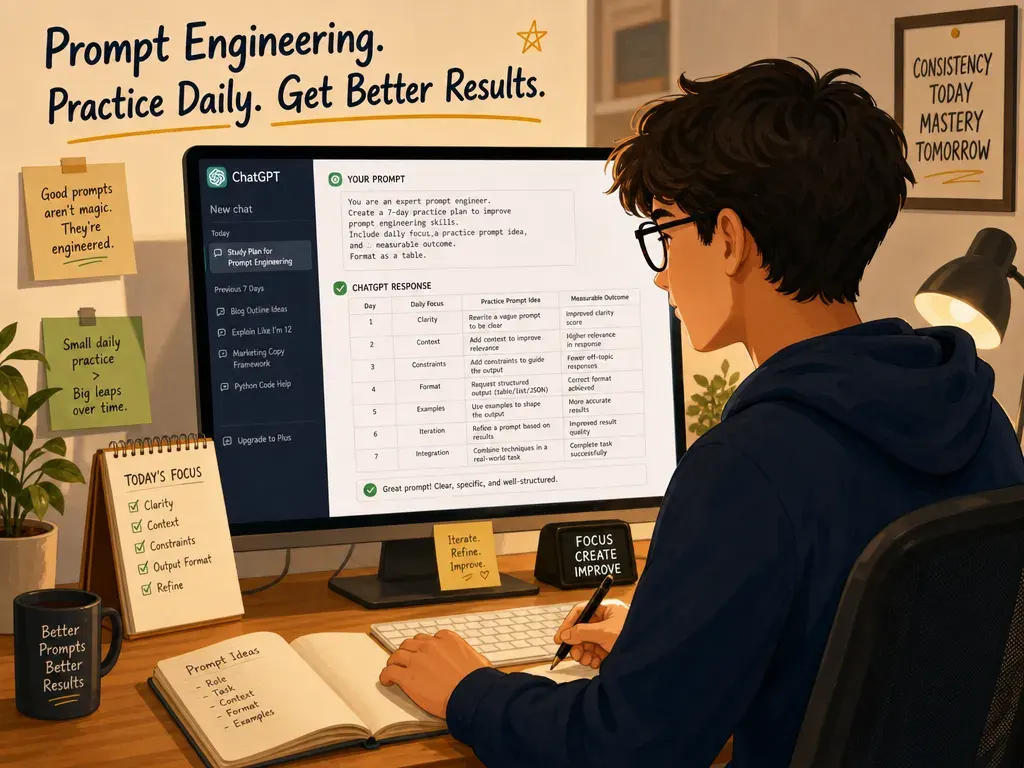
Your Practice Homework (Start Today)
Reading does not build this skill. Typing does. This week, write full 7-step prompts for these three tasks:
- A leave application to your college or office, for a real reason.
- A WhatsApp message inviting relatives to a family function.
- A study plan for any exam you or your sibling is preparing for.
For deeper study later, the official OpenAI prompt engineering guide is a good reference — but honestly, the 7 steps above cover everything a beginner needs for months.
FAQ: Prompt Engineering
Do I need perfect English to write good prompts?
No. AI understands simple and even broken English, plus Bengali and Hindi. Clear thinking matters more than fancy grammar. Say what you want, plainly — that is 90% of the skill.
Does the same prompting method work on ChatGPT, Gemini, and other AI?
Yes. The 7 steps work on every major AI tool. Learn the method once, use it everywhere — that is what makes it such a permanent skill.
How long does it take to become good at prompting?
Two weeks of daily practice makes you clearly better than most casual users. Two to three months of real projects makes it professional-level. It is the fastest-improving skill in the whole AI journey.
Is prompt engineering taught in AI courses?
In good ones, yes — it should be the backbone. In our AI Course for Beginners, prompting runs through all three months, practiced on real local projects: shop posters, resumes, business content, study material.
Final Words
Remember the two students from the first class?
Here is the part I did not tell you. Two weeks later, student one — the “write a job application” one — was writing the best prompts in the batch. Because this skill has no talent barrier. Only a practice barrier.
Seven steps. Role, task, details, format, tone, example, improve.
Open ChatGPT tonight and use all seven on one real task. That single habit, repeated daily, quietly puts you ahead of crores of people who are still typing one-word prompts.
Want to master prompting with a teacher checking your work? Visit our AI Course for Beginners page or come to the Habra centre for a free demo class — bring your phone, we will write your first professional prompt together.