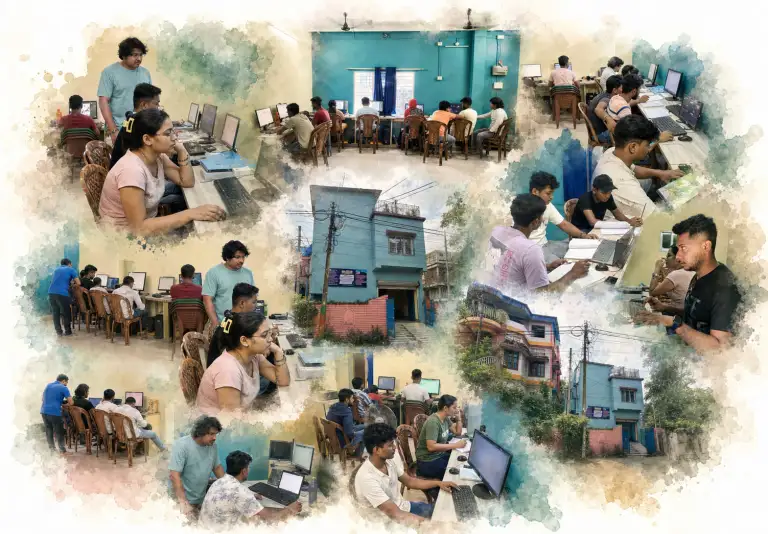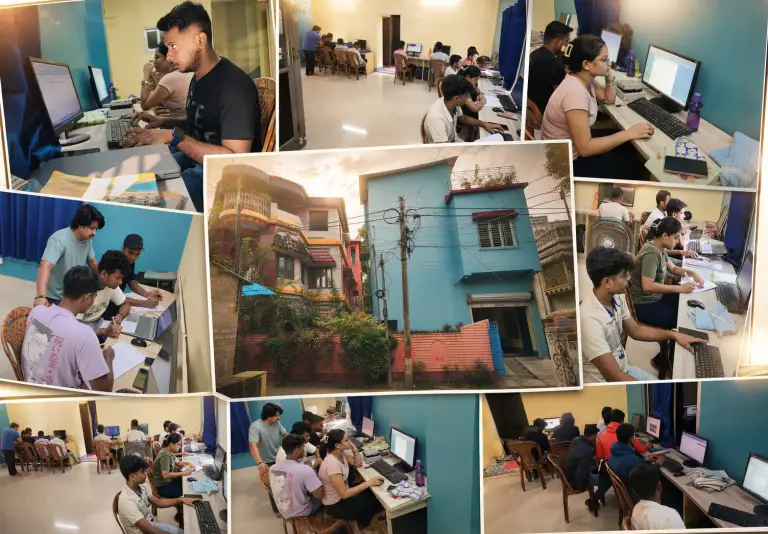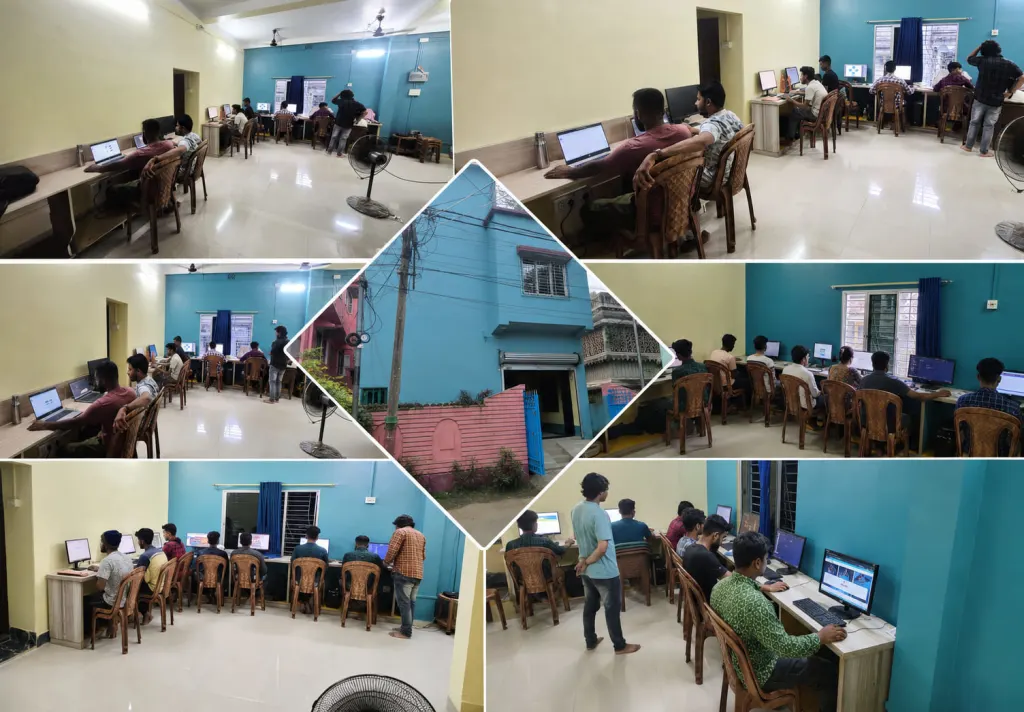
How long does it take to learn AI? One month? Six months? Two years? Everyone gives a different answer. Today I will give you a realistic timeline — based on what I actually see in our classroom in Habra, not based on YouTube dreams.
Before joining any course, every student asks me this question.
And I understand why.
Time is money. If you are a student, you have exams. If you are working, you have office. You are searching for a job, every month feels heavy.
So you deserve a real answer. Not a marketing answer.
Here it is.
How Long Does It Take to Learn AI? (Quick Answer)
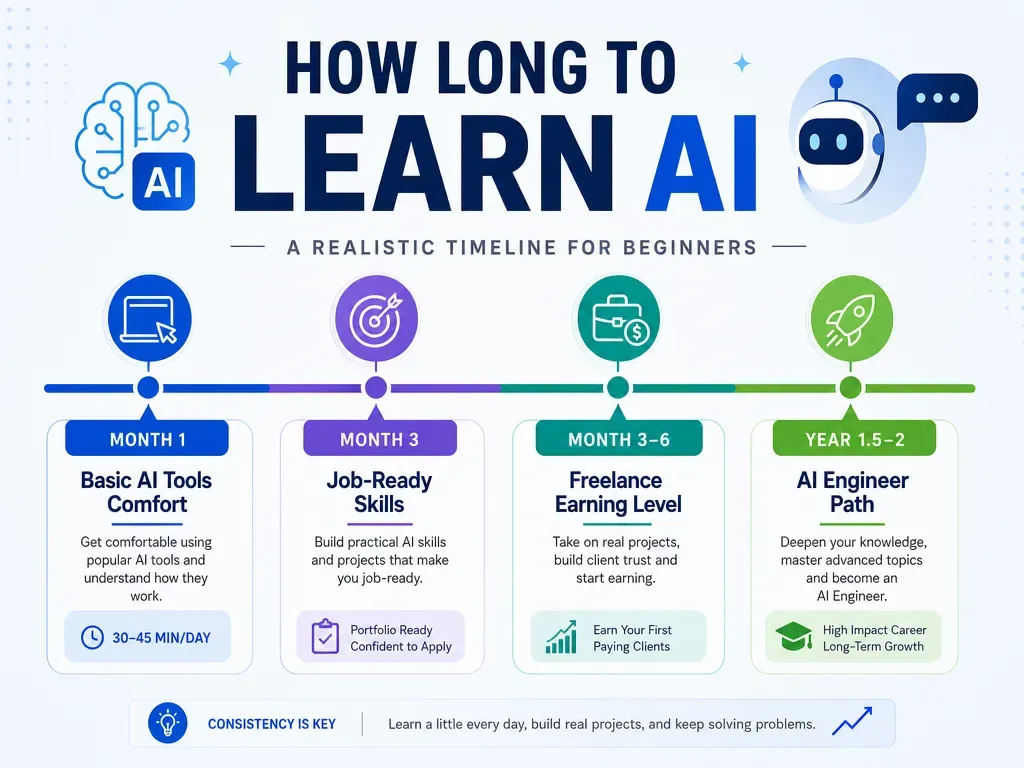
The honest answer depends on your goal. There is no single number. But here are the realistic timelines:
| Your Goal | Time Needed | Daily Practice |
|---|---|---|
| Basic comfort with AI tools | 1 month | 30–45 minutes |
| Job-ready AI tool skills | 3 months | 1–1.5 hours |
| Freelance earning level | 3–6 months | 1.5–2 hours |
| AI Engineer (with Python) | 1.5–2+ years | 3–4 hours |
Notice something important. For most people — the first three rows — the answer is between 1 and 6 months. Not years.
The “2 years” fear only applies to the engineer path. And as I explained in my post on learning AI without coding, most people never need that path.
Now let us break down each stage properly.
Month 1: Basic Comfort With AI Tools
This is the “learning to swim in shallow water” stage.
In your first month, with just 30–45 minutes daily, you can learn to:
- Talk to ChatGPT and Gemini properly and get useful answers
- Write emails, letters, and applications with AI help
- Make simple designs in Canva with AI features
- Understand basic words like prompt, chatbot, and generative AI
In our batches, I see this clearly. Week 1, students type one-line prompts and get average results. By week 4, the same students write detailed prompts and get 10x better results.
One month. That is all it takes to cross the fear stage.
Month 2–3: Job-Ready Skills
This is where casual users and serious learners separate.
In months 2 and 3, you go deeper:
- Prompt engineering — writing professional-level instructions for AI. This is the skill companies actually test.
- Multiple tools together — using ChatGPT for text + Canva for design + AI image tools for pictures, all in one project.
- Real projects — social media content for a shop, a full resume package, a small business presentation.
- Speed — work that took you 3 hours in month 1 now takes 30 minutes.
By the end of month 3, you can honestly write “AI tools” on your resume — and prove it in an interview with your projects.
This is exactly why our AI Course for Beginners is 3 months long. Not because 3 sounds like a nice number. Because 3 months of guided practice is what actually makes a beginner job-ready.
Month 3–6: Freelance and Earning Level
After 3 months, learning does not stop. But something changes.
Now you learn WHILE doing real work.
- Making posters for local shops and coaching centres
- Writing content for small businesses and YouTube channels
- Managing social media pages with AI tools
- Small freelance jobs on Fiverr and Upwork
The money starts small. ₹200 here, ₹500 there. But every rupee earned with a new skill builds confidence that no certificate can give.
What Makes You Faster or Slower?
Two students start on the same day. After 3 months, one is confident, one is still confused. Why? These five things decide your speed:
1. Daily practice beats weekend practice. 45 minutes every day is far better than 5 hours only on Sunday. AI skills are like cycling — regular touch matters.
2. Real tasks beat random playing. Students who use AI for their actual life — college notes, shop advertisements, job applications — learn 3x faster than those who only ask AI funny questions.
3. One path beats ten paths. People who jump between 20 YouTube playlists stay beginners forever. Pick one roadmap and finish it. I shared a complete one in How to Start Learning AI from Zero in 2026.
4. Guidance beats guessing. Alone, you waste weeks on doubts a teacher clears in 2 minutes. This is the biggest hidden time-saver of classroom learning.
5. English fear slows people the most. Not weak English — the FEAR of weak English. Students who type broken English without shame improve fastest. AI never laughs at anyone.
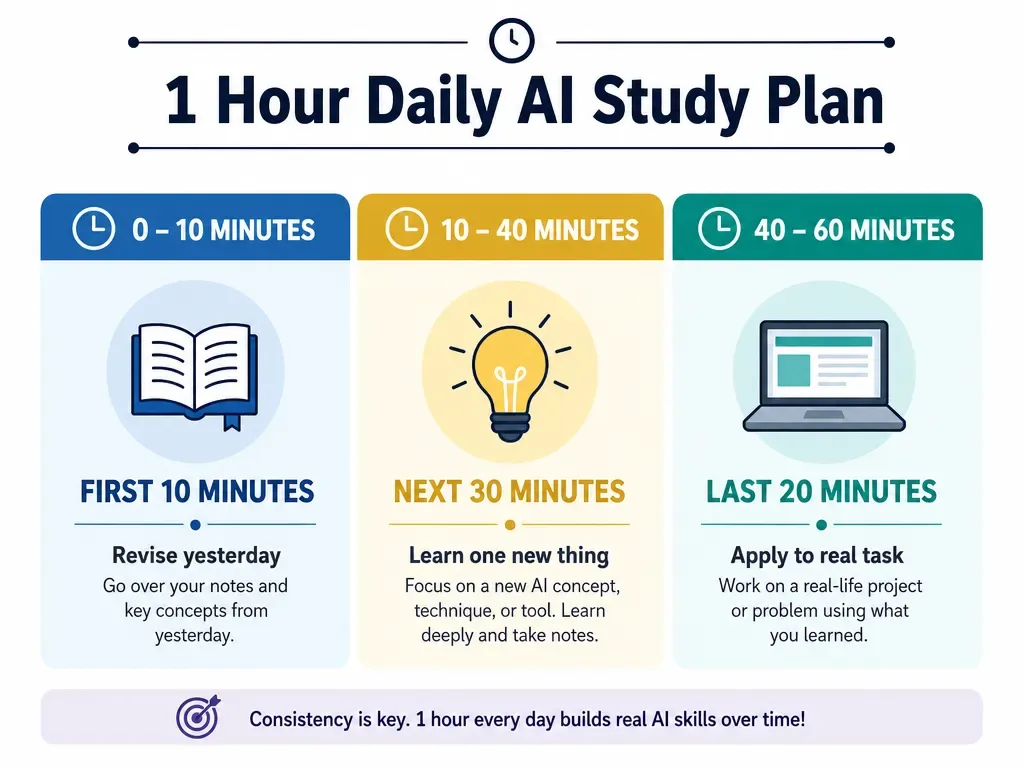
A Sample Daily Plan (Just 1 Hour)
Many people ask, “What should I do in that one hour?” Here is a simple daily plan:
- First 10 minutes: Revise yesterday’s learning. Open your notes.
- Next 30 minutes: Learn one new thing. One tool feature, one prompt style, one technique.
- Last 20 minutes: Apply it on a real task from your own life.
Do this for 90 days. Miss a day? No problem, continue the next day. Do not break the chain for more than 2 days — that is when most people quit.
3 Myths About AI Learning Time
Myth 1: “Learn AI in 7 days” courses.
You can get an INTRODUCTION in 7 days. Not a skill. Nobody learns swimming, driving, or English in 7 days. AI is the same. Anyone promising full AI skills in one week is selling you a dream.
Myth 2: “AI needs years of study before you can use it.”
The opposite extreme, equally wrong. This was true in 2018. In 2026, useful AI skills come in months, as you saw in the table above.
Myth 3: “I will learn when I get free time.”
The most dangerous myth, because it sounds responsible. Free time never comes. People who learned AI in 2023–24 are already ahead in jobs today. The best time to start was then. The second best time is this week.
FAQ: Time to Learn AI
Can I learn AI in 1 month?
You can become comfortable with basic AI tools in 1 month with daily practice. Job-ready skill needs about 3 months. Complete mastery is a lifelong journey — even teachers keep learning, because AI tools change every few months.
I can give only 30 minutes daily. Is it enough?
Yes, it is enough — your timeline will just stretch a little. With 30 minutes daily, basic comfort takes about 6 weeks instead of 4, and job-ready level takes about 4 months instead of 3. Slow and steady still wins.
Does age change the timeline?
Very little. In our centre, learners from class 10 students to 45-year-old shop owners follow almost the same 3-month journey. Regular practice matters. Age does not.
How long to become an AI engineer?
Realistically 1.5 to 2+ years of serious study — Python, maths, machine learning, projects. It is a good path with high salary, but only choose it if you truly enjoy coding. To understand the difference between these paths, read my post on AI vs machine learning vs generative AI.
Final Words
So, how long does it take to learn AI?
One month to lose the fear.
Three months to become job-ready.
Three to six months to start earning.
That is shorter than one college semester. Shorter than the time many people spend just “thinking about it.”
Ninety days from today, you will be 90 days older anyway. The only question is — with the skill, or without it?
Ready to start your 3-month journey with a teacher beside you? Visit our AI Course for Beginners page or come to our Habra centre for a free counselling talk. We will tell you honestly if this course is right for you — and honestly if it is not.